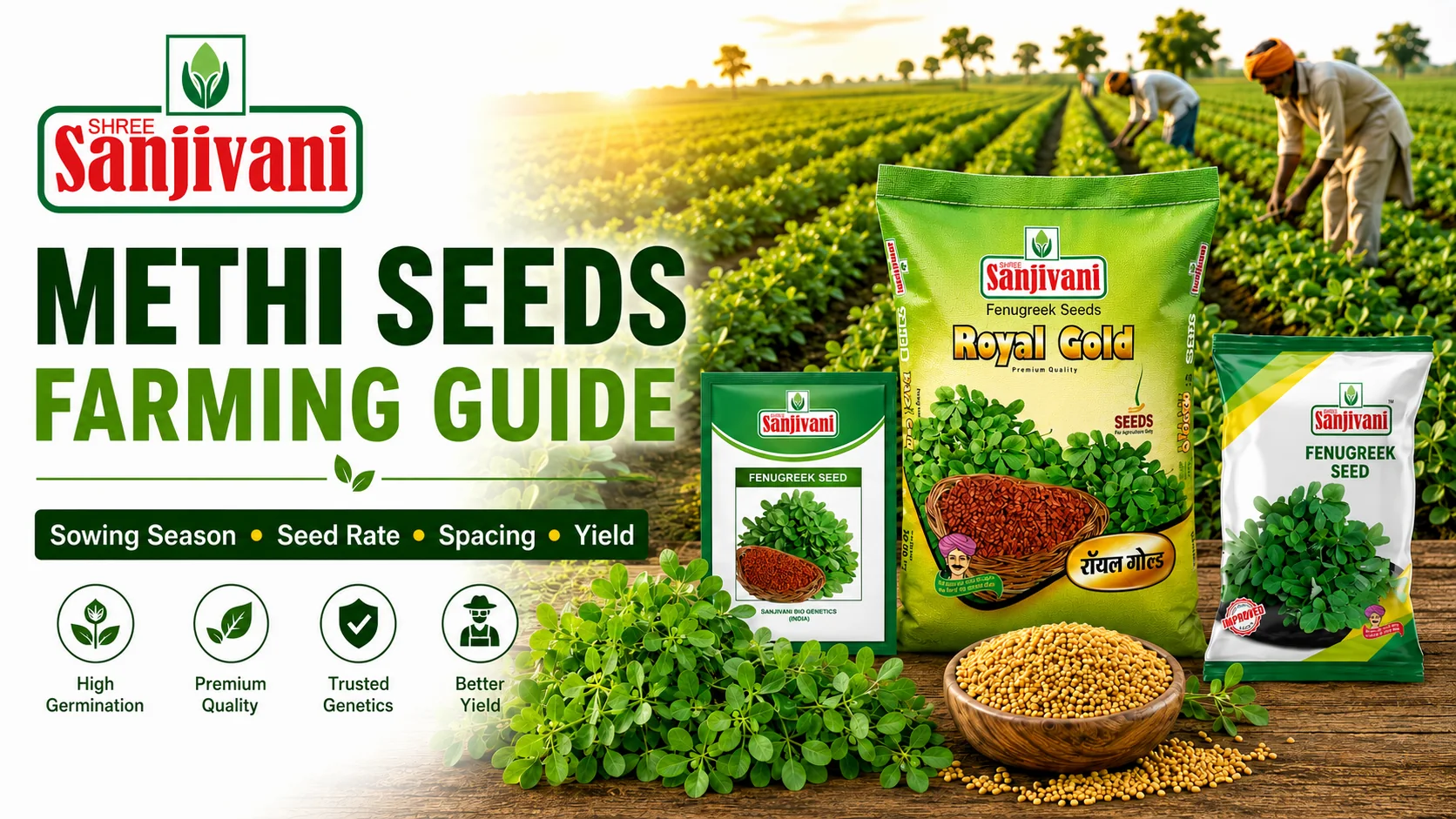
Methi Farming in India: Season, Seed Rate, Yield and Crop Duration
Methi, or fenugreek, can be grown for tender green leaves, dried aromatic leaves or mature grain. The crop may be the same, but the way it is planted, managed and harvested changes considerably according to the intended use.
A grower supplying fresh methi bunches is mainly interested in quick, healthy vegetative growth and leaf quality. A farmer taking the crop to maturity needs to think about flowering, pod development, crop duration and grain yield instead.
Quick answer: Methi is mainly grown during the cooler season in India, with October to November being an important sowing period in many regions. One established cultivation recommendation uses about 12 kg of seed per hectare, or roughly 5 kg per acre, while some regional recommendations use higher rates. Young greens may be ready in about 20–25 days, and grain varieties commonly mature in roughly 75–100 days.
Instead of treating one seed rate or harvest date as correct everywhere, use the selected variety, crop purpose and local conditions to make the final field plan.
Methi Cultivation at a Glance
| Factor | Practical reference |
|---|---|
| Main growing season | Cool season; October to November is important in many regions |
| Seed rate | Varies by region; around 12 kg/ha is one established recommendation |
| Spacing | Around 20 × 15 cm is one established field reference |
| Germination | Commonly begins in roughly 5–8 days under suitable conditions |
| First green harvest | Around 20–25 days in suitable leafy production |
| Grain crop duration | Commonly around 75–100 days depending on the variety |
| General green yield reference | Around 4–5 tonnes/ha |
| General grain yield reference | Around 500–700 kg/ha |
Choose the Crop Purpose Before Planting
Fresh methi, dried kasuri-type leaves and mature fenugreek grain are not harvested at the same stage. The market you intend to serve should therefore be clear before sowing.
For fresh leaves, tenderness, colour, aroma, vegetative growth and the ability to recover after cutting can be important. A grain crop is carried much further into its life cycle, so maturity, pod formation and grain characteristics become more important.
Some varieties are dual-purpose and can provide greens before the crop is allowed to flower and mature. Whether that is worthwhile depends on the variety and how much early cutting affects the final crop.
When planning several cool-season crops together, coriander farming has its own seed rate and crop-duration requirements, so it should not automatically be managed in the same way as methi.
How a Methi Plant Develops
Methi is a relatively quick-growing annual legume. After germination, the young plant develops small green leaflets and begins producing branches as vegetative growth increases.
For a leafy crop, this early vegetative stage is the part farmers and home growers want to encourage. Harvesting is done while the leaves and shoots remain tender.
If the crop is left in the field, the methi plant eventually enters flowering and pod formation. The pods contain the mature fenugreek seeds harvested for spice use or future planting.
This change from leaf growth to reproductive growth explains why a crop harvested repeatedly for greens cannot be evaluated in exactly the same way as a field intended mainly for grain.
Choosing a Methi Variety
The useful variety is the one that fits the intended harvest and region. A leafy grower and a grain grower may make different choices even when both are cultivating fenugreek.
| Type | Main purpose | What to compare |
|---|---|---|
| Leafy methi | Fresh green leaves | Vegetative growth, leaf colour, tenderness, aroma, bolting and regrowth |
| Grain type | Mature fenugreek seeds | Crop duration, pod formation, grain characteristics and regional adaptation |
| Dual-purpose type | Early greens followed by grain | Regrowth, maturity and the effect of early cutting on the final crop |
| Dried-leaf type | Aromatic dried methi leaves | Leaf quality, aroma and buyer requirement |
CO 1 and CO 2 are examples of documented fenugreek varieties. CO 1 is described as a dual-purpose variety with a crop duration of about 75–80 days, while CO 2 has a crop duration of about 85–90 days in its adapted regions.
Variety identity, germination information and packet condition should also be checked when choosing good quality seeds for sowing.
When to Grow Methi in India
Methi grows particularly well during comparatively cool and dry conditions. October to November is therefore an important sowing period in many Indian plains and commercial production regions.
The exact sowing month is not identical throughout India. Regional crop recommendations can differ according to temperature, altitude, rainfall, irrigation availability and the type of methi being grown.
The final date should follow the local climate, intended crop use and the variety being planted.
Can methi be grown outside winter?
Fenugreek can be cultivated outside the main Rabi window in some regions, but temperature and water availability become more important. High temperatures can shorten vegetative growth and push the crop toward flowering more quickly, which may reduce the quality window for fresh leaves.
Soil and Field Preparation
Well-drained loamy soil is suitable for fenugreek cultivation. The crop does not benefit from prolonged waterlogging, so drainage should be considered before sowing.
Because methi seeds are relatively small, a reasonably fine and level seedbed makes shallow, uniform sowing easier. Break large clods and remove weeds or heavy crop residue that could interfere with establishment.
Where organic manure forms part of the fertility programme, well-decomposed material can be incorporated during field preparation according to the farm's soil-management plan.
How Much Methi Seed Is Needed per Acre?
There is no single methi seed rate that should be applied to every farm in India because recommendations change with region, variety, sowing method and production system.
One established fenugreek cultivation recommendation uses 12 kg per hectare, which is approximately 5 kg per acre.
Some regional Rabi recommendations use a higher rate of 20–25 kg per hectare, equivalent to roughly 8–10 kg per acre.
| Production reference | Approx. per acre | Per hectare |
|---|---|---|
| Lower field reference | About 5 kg | About 12 kg |
| Higher regional field reference | About 8–10 kg | About 20–25 kg |
| Dense leafy production | Plant density may differ; use the selected variety and local leafy-crop recommendation | |
The difference between these recommendations is why seed quantity should be selected from guidance that matches the region and crop purpose rather than copied from an unrelated field.
If the germination of a seed lot is doubtful, simply increasing the quantity may hide the real problem. Check seed quality and germination before changing the planned rate.
Planting Methi Seeds in the Field
Line sowing makes it easier to maintain a reasonably uniform stand and gives better access for thinning, weeding and crop observation.
A spacing of around 20 × 15 cm is one established field reference for fenugreek cultivation. Local recommendations may differ, particularly where the crop is planted more densely for leafy harvest.
How deep should methi seeds be planted?
Place seed shallowly in a fine seedbed and cover it with enough soil to maintain moisture around the seed without burying it excessively.
After planting methi seeds, moisture should remain reasonably consistent during establishment. Heavy irrigation that leaves the field saturated can create more problems than it solves.
Methi Seed Germination and Early Growth
Under suitable moisture and temperature, methi seeds commonly begin germinating in roughly 5–8 days. The exact time varies with seed quality, soil temperature, sowing depth and moisture.
Uneven establishment can occur when:
- seed viability is poor;
- seed is planted too deeply;
- the upper soil layer dries soon after sowing;
- the bed remains waterlogged;
- soil crusting restricts emergence;
- the seedbed is very cloddy or uneven.
Once seedlings emerge, check whether the field has a reasonably even stand rather than judging the crop only from a few strong plants.
Managing Methi After Germination
Young methi needs adequate moisture but not continuously saturated soil. Irrigation frequency should follow soil type, temperature and rainfall rather than a rigid calendar.
Early weed control is particularly useful because weeds can compete with small methi plants before the crop closes the space between rows.
Nutrition should be based on soil fertility and local recommendations. Excessive nitrogen is not automatically helpful, particularly when it creates soft vegetative growth without improving the intended harvest.
Regular field inspection also helps identify problems such as aphids, powdery mildew, root rot or leaf spotting before they spread widely.
Where treatment is required, use locally registered crop-protection recommendations rather than applying a pesticide simply because it was mentioned in a general farming article.
Growing Methi for Fresh Leaves
For green methi, the aim is to harvest while the shoots are tender and marketable. Young greens may be ready at around 20–25 days under suitable growing conditions.
Methi can produce additional vegetative growth after cutting when enough healthy growing tissue remains. Later cuts depend on the variety, cutting height and how well the crop recovers.
Irrigation, soil fertility and temperature all influence the speed and quality of regrowth.
If the crop is also intended to produce mature grain, repeated heavy cutting can delay flowering or reduce the final grain crop. The priority should therefore be decided before repeated harvesting begins.
Methi Crop Duration and Grain Harvest
Fenugreek varieties do not all mature on the same day. Some varieties can mature at around 75–90 days, while other grain crops may require roughly 90–100 days depending on the variety and field conditions.
| Crop use | Harvest stage | Approximate timing |
|---|---|---|
| Tender green methi | Young shoots and leaves | Around 20–25 days |
| Repeated leafy crop | Further cuts after healthy regrowth | Variety and management dependent |
| Earlier grain varieties | Pods mature and plants begin drying | Approximately 75–90 days |
| Longer grain crop | Mature pods and firm seed | Can approach 90–100 days or longer |
For grain production, harvest as the crop approaches maturity and the pods contain fully developed seed. Waiting too long can increase losses if dry pods begin opening or shedding seed.
Methi Yield per Acre and per Hectare
Yield depends heavily on whether the farmer is measuring fresh leaves or mature grain, so the two should be treated separately.
A general fenugreek cultivation reference is approximately 4–5 tonnes of green produce per hectare and about 500–700 kg of mature grain per hectare.
| Output | Approx. per acre | Reference per hectare |
|---|---|---|
| Fresh green methi | About 1.6–2 tonnes | About 4–5 tonnes |
| Mature fenugreek grain | About 200–280 kg | About 500–700 kg |
These are reference values rather than guaranteed outputs. Individual varieties may perform differently, and crop stand, season, fertility, irrigation, weeds, pests, diseases and harvest losses all influence the final result.
The general cultivation, crop duration and yield references are consistent with TNAU fenugreek cultivation guidance .
Drying and Storing Fenugreek Seeds
Mature fenugreek seed should be dried sufficiently before storage. Grain stored with excess moisture is more vulnerable to deterioration, fungal growth and insect problems.
Use clean, dry bags or containers and keep stored seed away from damp floors and direct moisture.
Seed retained specifically for future sowing needs greater care than grain intended only for food use because poor storage can reduce subsequent germination.
Choosing Methi Seed for the Intended Use
Commercial growers should first decide whether the crop is intended mainly for leaves, grain or both. Pack quantity can then be selected according to cultivated area and the locally appropriate seed rate.
For larger farm requirements, Royal Gold fenugreek seeds and Fenugreek Methi Seeds are available in larger pack formats.
For a kitchen garden or a much smaller planting area, Fenugreek Garden Seeds provide a smaller-pack option.
Current price and stock can change, so those details are best checked on the individual product page rather than fixed permanently inside the farming article.
Frequently Asked Questions About Methi Farming
Which season is best for growing methi in India?
Methi is primarily a cool-season crop. October to November is an important sowing period in many Indian regions, although the exact window varies with location, variety and whether the crop is being grown for leaves or grain.
What is the methi seed rate per acre?
Seed-rate recommendations vary by region. A recommendation of 12 kg per hectare equals roughly 5 kg per acre, while some regional recommendations use around 20–25 kg per hectare, or roughly 8–10 kg per acre. Use the recommendation appropriate to your variety, region and production method.
How long do methi seeds take to germinate?
Methi commonly starts germinating within roughly 5–8 days when viable seed is planted shallowly in moist, well-drained soil. Temperature, moisture and seed quality can affect the actual time.
How long does a methi crop take to grow?
Young methi greens can be harvested around 20–25 days after sowing in suitable production systems. Grain varieties commonly take around 75–100 days depending on the variety and growing conditions.
What is the methi yield per acre?
A general grain reference of 500–700 kg per hectare is approximately 200–280 kg per acre. Fresh-green yield of 4–5 tonnes per hectare is approximately 1.6–2 tonnes per acre. Actual output varies significantly with variety and crop management.
How should methi seeds be planted?
Methi can be line sown in a fine, well-drained seedbed. Around 20 × 15 cm is one established spacing reference for field cultivation, although denser planting may be used for some leafy production systems.
Will methi grow again after cutting?
Leafy methi can produce further vegetative growth after cutting when enough healthy growing tissue remains. Regrowth depends on the variety, cutting height, irrigation, nutrition and weather.
Which methi variety is best for farming?
There is no single methi variety that is best for every farm. Choose according to whether the crop is intended for fresh leaves, dried leaves, mature grain or dual-purpose production, then consider duration, regional adaptation and buyer requirements.
Conclusion
Growing methi successfully starts with deciding what the crop will be harvested for. Fresh-leaf production requires healthy vegetative growth, while grain production carries the same plant through flowering, pod development and full maturity.
October to November is an important planting period in many regions, but seed rate, spacing and crop duration should be adjusted to the variety and local recommendation rather than treated as fixed national numbers.
Healthy establishment, sensible moisture management, timely weed control and harvesting at the correct stage give the crop a stronger foundation whether the final product is fresh methi leaves or mature fenugreek grain.