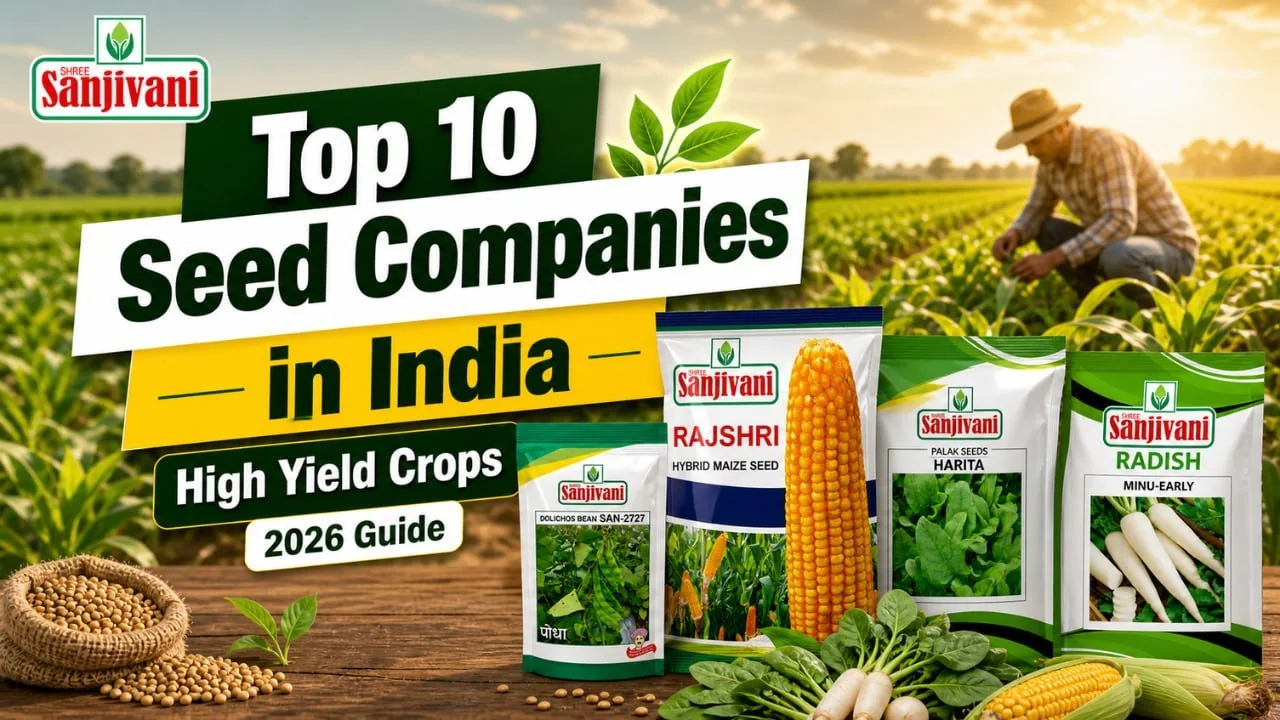
Top 10 Seed Companies in India: A Practical 2026 Comparison
Choosing a seed company is an important part of planning a crop, but experienced growers rarely make the decision on the company name alone. The real comparison begins with the crop, the variety and the conditions in which that variety will be grown.
India's seed market includes long-established research-led companies, large seed manufacturers, vegetable specialists, regional businesses and suppliers working across different crop segments. Some have broad portfolios covering several field crops, while others are particularly strong in vegetables, maize, forage or specific regional markets.
At a glance: Sanjivani Seeds, Mahyco, Nuziveedu Seeds, Kaveri Seed Company, Rasi Seeds, Advanta Seeds, Syngenta India, Bayer Crop Science India, JK Agri Genetics and VNR Seeds are among the companies farmers may come across while comparing agricultural seed options in India. The useful choice depends on the crop and the particular variety, not on one company being suitable for every farm.
For example, maize growers may need to think about maturity, grain type, standability or fodder use. Vegetable growers may be more concerned with fruit shape, firmness, colour, harvest pattern and whether the produce matches local market demand. Pulse and forage crops bring a different set of priorities again.
The ten companies below therefore provide a useful starting point rather than a shortcut to variety selection. After narrowing the company choices, the final decision should be made by looking closely at the seed that will actually go into the field.
Top Seed Companies in India: Quick Comparison
The companies in this list cover different parts of Indian agriculture. The table gives a broad view of where each one fits so that farmers and growers can narrow their search before comparing individual varieties.
| No. | Company | Crop focus | What matters when comparing |
|---|---|---|---|
| 1 | Sanjivani Seeds | Maize, moong, onion, vegetables, hybrid vegetables, field crops, forage and kitchen garden seeds | Variety choice, crop purpose, pack size, sowing requirement and availability |
| 2 | Mahyco | Field crops and vegetables | Crop-specific variety, maturity, regional suitability and production requirement |
| 3 | Nuziveedu Seeds | Cotton, maize, paddy and other field crops | Maturity, crop adaptation and suitability of the individual hybrid or variety |
| 4 | Kaveri Seed Company | Maize, cotton, rice and selected vegetables | Season, maturity, local growing conditions and crop purpose |
| 5 | Rasi Seeds | Cotton and selected field crops | Regional suitability, crop duration and individual variety characteristics |
| 6 | Advanta Seeds | Maize, sorghum, forage and vegetables | Grain or fodder use, maturity, plant type and local conditions |
| 7 | Syngenta India | Commercial vegetables and selected field crops | Marketable produce, plant characteristics, disease pressure and season |
| 8 | Bayer Crop Science India | Rice, corn, cotton, fruits and vegetables | Specific variety, recommended region and crop-management requirement |
| 9 | JK Agri Genetics | Maize, cotton, vegetables and fodder crops | Crop adaptation, maturity and conditions in which the variety will be grown |
| 10 | VNR Seeds | Commercial vegetables and selected crops | Fruit quality, market preference, harvest characteristics and variety fit |
Practical point: A familiar company can make it easier to build a shortlist, but farmers should still compare the actual varieties intended for the same crop, season and production purpose.
10 Seed Companies Farmers Can Compare
1. Sanjivani Seeds
Sanjivani Seeds works across several crop groups, including maize, moong, onion, vegetables, hybrid vegetables, field crops, forage crops and smaller kitchen-garden packets. The range gives farmers and growers a way to compare different crop requirements within one catalogue rather than treating every seed as the same type of purchase.
The useful decision still happens at variety level. A farmer choosing maize, for instance, may need a completely different product depending on whether the aim is grain, sweet corn, white corn or another use. Vegetable growers have to make similar distinctions around fruit type, maturity and market.
2. Mahyco
Mahyco is one of the long-established names in the Indian seed sector and is associated with both field crops and vegetables. Its broad crop presence makes it relevant to growers who want to compare established seed businesses across more than one crop.
The company name, however, is only the first filter. Two varieties sold under the same brand may differ considerably in maturity, adaptation and intended farming conditions, so the technical fit of the individual variety remains more important than familiarity with the company.
3. Nuziveedu Seeds
Nuziveedu Seeds is widely associated with commercial field crops and has products across cotton, maize, paddy and other agricultural segments. It is often part of the comparison where farmers are planning larger field-crop acreage and need to look at maturity, local adaptability and crop-specific characteristics.
For these crops, comparing varieties under similar conditions is particularly useful. A hybrid that performs well in one region or sowing window cannot automatically be assumed to behave the same way under different soil, rainfall or irrigation conditions.
4. Kaveri Seed Company
Kaveri Seed Company has a recognised presence across maize, cotton, rice and other crop segments. Its broad field-crop portfolio makes it one of the businesses farmers may consider when looking at commercial seed options for different seasons.
For maize in particular, variety choice depends on more than the company behind the packet. Farmers comparing maize seed companies in India still need to look at maturity, grain or fodder purpose, standability, irrigation and suitability for their local growing conditions.
5. Rasi Seeds
Rasi Seeds has a long presence in field crops and is commonly associated with crops such as cotton and other broad-acre farming segments. For farmers, the important consideration is whether the company's available variety matches the intended crop cycle and regional conditions.
Recent performance from farms with similar soil, climate and management can often be more useful than a general reputation. This is especially true when a new variety is being considered for a large part of the farm.
6. Advanta Seeds
Advanta has a portfolio spanning maize, sorghum, forage and vegetables. That mix makes the company particularly relevant where growers need to distinguish between seed intended for grain production and seed intended for fodder, silage or other crop uses.
Those purposes require different traits. A dairy farmer looking for biomass and fodder quality will not necessarily value the same characteristics as a farmer growing a grain crop. Defining the end use first makes the company and variety comparison much more meaningful.
7. Syngenta India
Syngenta has a strong presence in commercial vegetables along with selected field-crop seed segments. For vegetable growers, the comparison often moves beyond basic crop establishment into traits that influence what can actually be sold.
Fruit size, shape, colour, firmness, picking pattern, transportability and local buyer preference may all affect the commercial value of a vegetable hybrid. A variety with attractive production figures is not automatically the right choice if the harvested produce does not fit the target market.
8. Bayer Crop Science India
Bayer Crop Science works across several major agricultural segments, including seed-related activity in crops such as rice, corn, cotton, fruits and vegetables. It is one of the larger names farmers may encounter while comparing crop inputs and varieties.
As with any large portfolio, it is better to judge the exact seed product than the size of the company. Regional recommendations, crop maturity, intended use and the information supplied with the variety should carry more weight in the final decision.
9. JK Agri Genetics
JK Agri Genetics works across field crops, vegetables and fodder-related segments, including maize and cotton. A multi-crop portfolio can be useful for farmers and dealers, but each crop needs its own comparison criteria.
In a field crop, growers may focus on duration, plant strength and adaptation. With vegetables, produce quality and harvest behaviour may become more important. The same company can therefore be evaluated differently depending on what is being grown.
10. VNR Seeds
VNR Seeds is particularly associated with commercial vegetable breeding and varieties. This makes it relevant where growers are comparing tomato, chilli, gourds, okra and other vegetable crops for fresh-market production.
Farmers comparing vegetable seed companies in India should look beyond the number of varieties in a catalogue. Fruit quality, shelf life, harvest pattern, disease pressure and local mandi preference often decide whether a vegetable hybrid makes commercial sense.
What Actually Matters When Choosing a Seed Company?
Farmers naturally pay attention to reputation because seed is bought before its performance can be seen in the field. A known company or seed brand can reduce some uncertainty, but reputation is most useful when it is combined with a careful look at the individual variety.
Start with the crop you are actually growing
A company with a strong cotton portfolio is not automatically the most relevant choice for a tomato grower. The first shortlist should therefore be based on businesses that have meaningful options in the crop you intend to sow.
Match the seed to the purpose of the crop
Even within one crop, the goal can change the decision. Maize may be intended for grain, green cob, sweet corn, fodder or silage. Vegetables may be grown for a nearby market, long-distance transport, processing or direct sale.
The characteristics needed from the seed should follow that purpose.
Look closely at the exact variety
This is where many comparisons become more useful. A seed company may have several varieties of the same crop, each with different maturity, plant type, produce characteristics or recommended conditions.
The broader principles used when choosing seeds for farming in India remain the same regardless of brand: start with crop purpose, season, local conditions and the exact variety.
Consider local experience
A recommendation from a region with very different rainfall, temperature, soil or irrigation may not tell you much about your own field. Results from nearby farms or similar production conditions can provide more useful evidence.
If a new variety is unfamiliar locally, trying it on a manageable area before expanding can reduce the risk of making the entire crop dependent on one untested choice.
Think about the market before sowing
For market-oriented crops, successful production is only part of the decision. Fruit, grain or produce characteristics need to match what buyers expect.
A vegetable variety with good field performance may still be difficult to sell if its size, shape, colour or shelf life does not suit the local market. The same principle applies to grain type and fodder use in field crops.
What to Check Before You Open the Seed Packet
Once a variety has been selected, the packet itself becomes an important part of the purchase. Whether seed is bought directly, from a dealer or through another seed supplier, keep enough information to identify exactly what was purchased and from where.
- Crop and variety: make sure the packet contains the variety you intended to buy, not simply the same crop from the same company.
- Lot or batch details: retain these details together with the invoice.
- Net quantity: check whether the product is sold by weight or seed count and whether it is sufficient for the planned area.
- Germination and purity information: check the information declared on the packet.
- Validity: confirm that the packet is within the relevant testing or validity period shown on it.
- Seed treatment: follow handling instructions for treated agricultural seed.
- Seal and packet condition: avoid packets that appear opened, damaged or poorly stored.
- Seller traceability: keep the invoice or purchase record, especially for a commercial crop.
These simple checks are often more useful than relying on packaging design or a familiar logo alone.
A Good Brand Still Needs the Right Variety
Seed brands are useful because they help growers recognise companies they have dealt with before, but a brand cannot remove the need for variety selection.
One company may sell an early and a longer-duration variety of the same crop. Another may have hybrids suited to different fruit types or growing seasons. The fact that both packets carry the same company name does not make them interchangeable.
This is particularly important with hybrid crops. Farmers comparing hybrid seed companies in India should pay close attention to the traits of the actual hybrid rather than assuming that every hybrid from a familiar company will perform in the same way.
In practice, experienced growers tend to combine several sources of information: the product details, local experience, previous crop performance, seasonal conditions and the needs of the final market.
Frequently Asked Questions
Which are the top 10 seed companies in India?
Companies farmers may commonly compare include Sanjivani Seeds, Mahyco, Nuziveedu Seeds, Kaveri Seed Company, Rasi Seeds, Advanta Seeds, Syngenta India, Bayer Crop Science India, JK Agri Genetics and VNR Seeds. The most suitable choice depends on the crop and individual variety required.
Which seed company is best in India?
There is no single company that is best for every farmer or crop. A more useful approach is to shortlist companies active in the required crop and then compare their varieties according to season, maturity, crop purpose, local conditions and previous field performance.
How should farmers compare seed companies?
Start with companies that offer the crop you need. Then compare the exact variety, recommended growing conditions, maturity, crop purpose, packet information and experience from similar farms or regions.
Does the seed brand matter?
Brand reputation can help create an initial shortlist, but the variety matters more in the field. Different varieties from the same company can have different maturity, plant type, crop characteristics and regional suitability.
Should farmers choose seed only by yield potential?
No. Yield potential is only one part of the decision. Crop duration, local adaptability, disease pressure, irrigation, produce quality, harvest timing and market requirements can all affect the value of a variety.
What should be checked on a seed packet?
Check the crop and variety name, lot details, quantity, germination and purity information, validity, treatment information, company details and the condition of the sealed packet.
Is a well-known seed company always the safest choice?
A recognised company can provide confidence, but the final result still depends on the individual variety and how well it matches local conditions. A suitable variety from a relevant crop portfolio is generally more important than company size alone.
Conclusion
Comparing seed companies is useful because it helps farmers narrow a very large market into a manageable shortlist. But the company name should not become a substitute for choosing the right variety.
Start with businesses that have a meaningful presence in your crop. Then compare varieties for maturity, crop purpose, local conditions, packet information and the type of harvest or market you are aiming for.
The strongest choice is usually not the most familiar name on the shelf. It is the seed variety that makes sense for the farm where it will actually be grown.