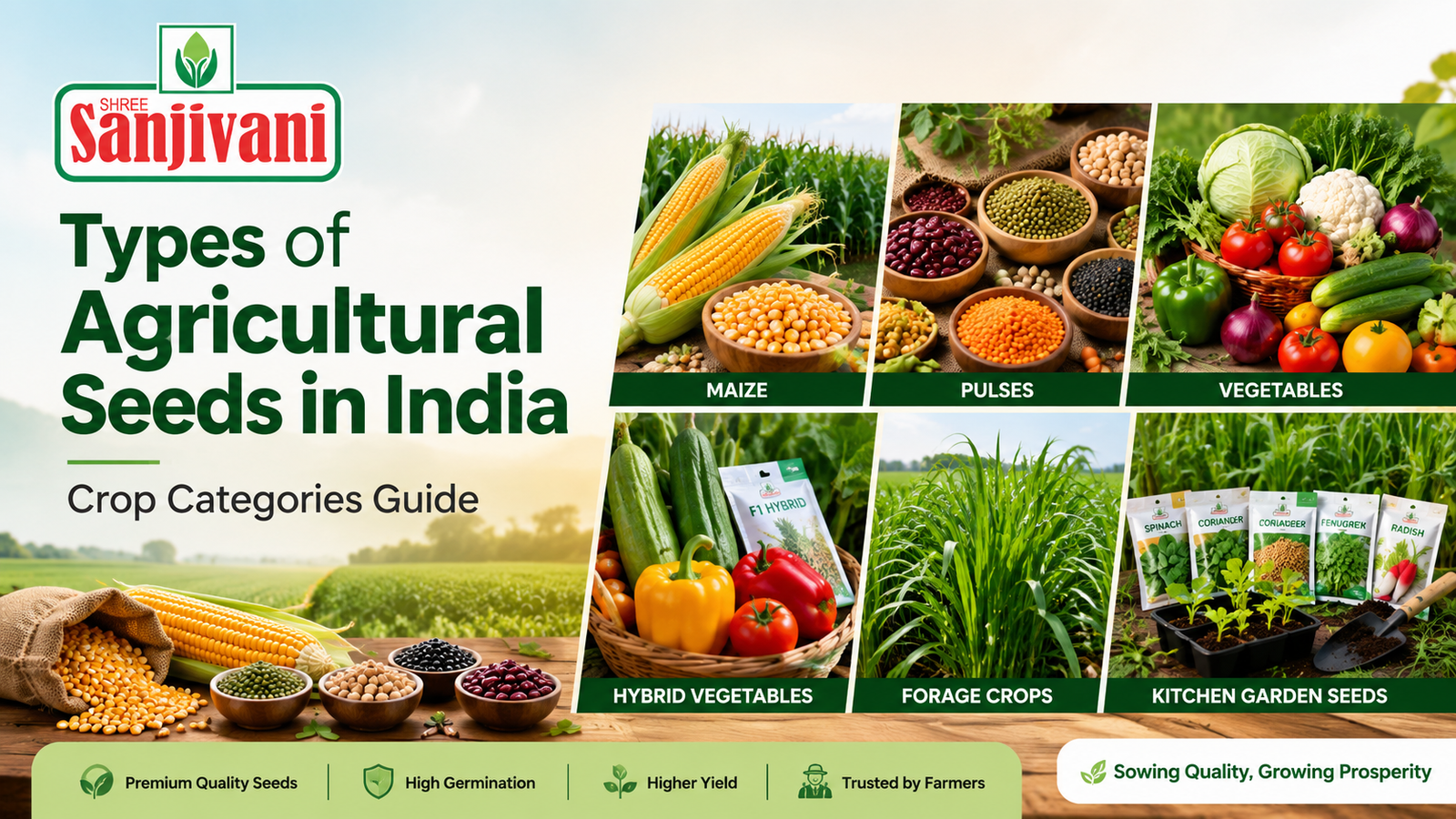
Types of Agricultural Seeds in India: Seed Classes & Crop Groups
The phrase “type of seed” can mean different things in agriculture. A plant breeder may be talking about breeder or foundation seed, a farmer may be choosing between a hybrid and an open-pollinated variety, while a seed dealer may organise products as maize, pulses, vegetables or forage crops.
These are all useful classifications, but they describe different things. Mixing them together can make seed terminology unnecessarily confusing.
Quick answer: Agricultural seeds in India can be understood in three main ways: by their place in the seed multiplication system, by the way the variety is bred, and by the crop in which the seed will be used. The multiplication chain commonly includes nucleus, breeder, foundation and certified seed, while truthfully labelled seed is another commercial quality-seed route. Farmers also encounter hybrids, open-pollinated varieties and crop groups such as maize, pulses, vegetables and forage.
Understanding which classification is being used makes the rest of the terminology much easier. A tomato hybrid, for example, tells you something about the breeding of the variety. “Certified seed” describes something different: the seed-production and certification system through which a seed lot has been produced.
Agricultural Seeds Can Be Classified in More Than One Way
There is no single list that describes every agricultural seed correctly because farmers, breeders and seed businesses use different classifications for different purposes.
| How seed is classified | What it tells you | Examples |
|---|---|---|
| Seed multiplication class | Where the seed sits in the multiplication and quality-assurance chain | Nucleus, breeder, foundation, certified and truthfully labelled seed |
| Breeding type | How the variety was developed and how its genetics are maintained | Hybrid and open-pollinated varieties |
| Crop or use | What kind of crop the farmer intends to establish | Maize, pulses, vegetables, onion, forage, fodder and other field crops |
The same packet can belong to more than one classification at the same time. A seed can be a vegetable crop, a hybrid variety and part of a particular quality or labelling system without those terms meaning the same thing.
The Seed Multiplication Chain in India
Seed production begins with a relatively small quantity of carefully maintained genetic material and is multiplied through successive stages until sufficient seed is available for wider cultivation. Each stage has a different role.
Nucleus seed
Nucleus seed is the original, highly pure seed stock maintained by the breeder or institution responsible for a variety. Its main purpose is to preserve the identity of that variety and provide the source material from which breeder seed can be produced.
Farmers generally do not encounter nucleus seed as an ordinary commercial farm purchase. It belongs much earlier in the seed multiplication process.
Breeder seed
Breeder seed is produced under the direct control or supervision of the breeder responsible for the variety. Maintaining genetic identity and purity is the central purpose at this stage.
Breeder seed is mainly used to produce the next generation of seed rather than being the normal seed supplied for large-scale commercial cultivation.
Foundation seed
Foundation seed is produced from breeder seed while maintaining prescribed standards of genetic identity and purity. Its production is supervised within the seed certification system.
The purpose of foundation seed is multiplication: it provides the source from which larger quantities of certified seed can be produced.
Certified seed
Certified seed is generally produced from foundation seed under the supervision of the appropriate seed certification system and according to prescribed standards.
This is the stage farmers are much more likely to encounter in commercial crop production because sufficient quantities can be multiplied for wider agricultural use.
Truthfully labelled seed
Truthfully labelled seed follows a different quality-assurance route from formally certified seed. The seed is sold with prescribed information on the label, and responsibility for the declared quality information rests with the producer or seller.
Certified seed and truthfully labelled seed can both reach farmers for commercial cultivation, but the way their quality assurance is administered is different.
Hybrid and Open-Pollinated Seeds Describe the Variety, Not the Seed Class
This distinction is easy to miss because the words often appear together on seed packets and product catalogues.
A hybrid is produced by crossing selected parent lines to obtain a particular combination of characteristics in the resulting generation. The traits being targeted depend on the crop and breeding programme and may include characteristics such as plant type, maturity, uniformity, marketable produce or resistance to particular stresses.
An open-pollinated variety maintains its characteristics through normal pollination within the variety when appropriate isolation and seed-production practices are followed.
Neither term tells you whether the seed lot is breeder, foundation, certified or truthfully labelled. Those classifications describe a different part of seed production.
Simple example: “hybrid” answers a question about the variety's breeding, while “certified” answers a question about how a seed lot has moved through a recognised production and quality-assurance system.
Common Agricultural Seed Groups Farmers Buy
Away from seed-production terminology, farmers and dealers also group seed by the crop being planted. This is the most practical classification when someone is deciding what to grow in a field, nursery or garden.
| Crop group | Common examples | Main use |
|---|---|---|
| Field crops | Cereals, pulses, oilseeds and other broad-acre crops | Seasonal agricultural production over field areas |
| Maize and corn | Grain maize, white corn, sweet corn and other maize types | Grain, fresh cob and other crop-specific uses |
| Pulses | Moong, urad, tur and other pulse crops | Pulse and grain production |
| Vegetables | Tomato, chilli, okra, gourds, radish, spinach, peas and beans | Fresh-market, commercial and home vegetable production |
| Forage and fodder | Berseem, fodder bajra and sorghum-Sudan grass | Green fodder and livestock-feed production |
| Kitchen garden | Small packets of vegetables and herbs | Home gardens, terraces, grow bags and small plots |
Field crop seeds
Field crops cover crops normally grown over agricultural field areas and may include cereals, pulses and other seasonal crops. The exact grouping varies from one seed catalogue to another.
Sanjivani's field crop seeds include agricultural options that sit alongside separate maize, moong and other crop-specific ranges.
Maize and corn seeds
Maize deserves separate treatment because the crop itself can have several uses. Grain maize, white corn and sweet corn are related crops, but the farmer may be producing them for quite different markets.
The current maize seeds range therefore contains several types of corn rather than one interchangeable product.
Pulse seeds
Pulse crops include moong, urad, tur and several related grain legumes. Their place in the rotation and their seasonal use distinguish them from cereal and vegetable crops.
Green gram products are grouped separately as moong seeds , while other pulses may appear within the wider field-crop range.
Vegetable seeds
Vegetable seeds cover a particularly diverse group of crops. Tomato, chilli, okra, cucumber, gourds, radish, spinach and beans differ greatly in plant habit, harvested part and production system, even though all are sold within the vegetable market.
Sanjivani's vegetable seeds range includes both field-scale and smaller vegetable crop options.
Forage and fodder seeds
Forage crops are grown primarily for livestock feed rather than for grain or vegetable harvest. Berseem, fodder bajra and sorghum-Sudan grass are examples of crops that fit this group.
These are organised separately under forage crop seeds because their purpose in the farming system is different from grain and vegetable crops.
Kitchen garden seed packets
Kitchen garden seed is not a separate botanical or seed-certification class. It is mainly a practical pack and market category for people growing vegetables and herbs in smaller quantities.
The kitchen garden seed packets range uses smaller quantities suited to home gardens, terraces and compact growing spaces.
Why These Seed Terms Should Not Be Used Interchangeably
A common source of confusion is treating crop groups, breeding types and seed classes as though they describe the same thing.
Consider a commercial tomato hybrid. “Tomato” identifies the crop. “Hybrid” describes the type of variety. Any certification or labelling information on the commercial seed lot describes another part of the seed system.
The same is true for maize, moong or forage crops. Knowing that something is maize seed tells you the crop, but it does not automatically tell you the breeding method or where the seed sits in a multiplication and quality-assurance system.
Once the terminology is clear, the next decision is the individual variety. In practice, choosing seeds for farming in India still depends on the actual crop, variety, season and local conditions rather than the category name alone.
Frequently Asked Questions
What are the main types of agricultural seeds in India?
Agricultural seeds can be classified in several ways. The seed multiplication system includes nucleus, breeder, foundation and certified seed, while truthfully labelled seed is another commercial quality-seed route. Seeds can also be described as hybrids or open-pollinated varieties and grouped by crops such as cereals, pulses, vegetables and forage.
What is the difference between breeder, foundation and certified seed?
Breeder seed is maintained under the control of the breeder and provides material for further multiplication. Foundation seed is produced from breeder seed while maintaining prescribed standards, and certified seed is generally produced from foundation seed for wider commercial cultivation.
What is truthfully labelled seed?
Truthfully labelled seed is sold with prescribed information declared by the producer or seller, who is responsible for those quality claims. It differs from certified seed, where certification is carried out through a seed certification agency.
Are hybrid seed and certified seed the same?
No. Hybrid describes the breeding of the variety. Certified describes the seed-production and quality-assurance status of a seed lot. The two terms answer different questions about the seed.
What are some common agricultural seed crop groups?
Common groups include cereals and maize, pulses such as moong and urad, vegetable crops such as tomato, chilli and okra, onion and other field crops, and forage crops such as berseem, fodder bajra and sorghum-Sudan grass.
Are vegetable seeds and forage seeds different seed classes?
No. Vegetable and forage describe the crop or its agricultural use. Breeder, foundation and certified describe stages in seed multiplication and quality assurance.
Is kitchen garden seed a special agricultural seed class?
No. Kitchen garden seed is mainly a pack and use category. It usually refers to smaller quantities of vegetable or herb seed intended for home gardens, terraces and compact growing areas.
Conclusion
Agricultural seed terminology becomes much clearer once the different classifications are kept separate.
Nucleus, breeder, foundation, certified and truthfully labelled seed describe the seed-production system. Hybrid and open-pollinated describe the variety and its breeding. Maize, pulses, vegetables and forage describe the crop or agricultural use.
A seed packet can belong to several of these categories at the same time, which is why understanding the terms is more useful than trying to force every agricultural seed into one simple list.