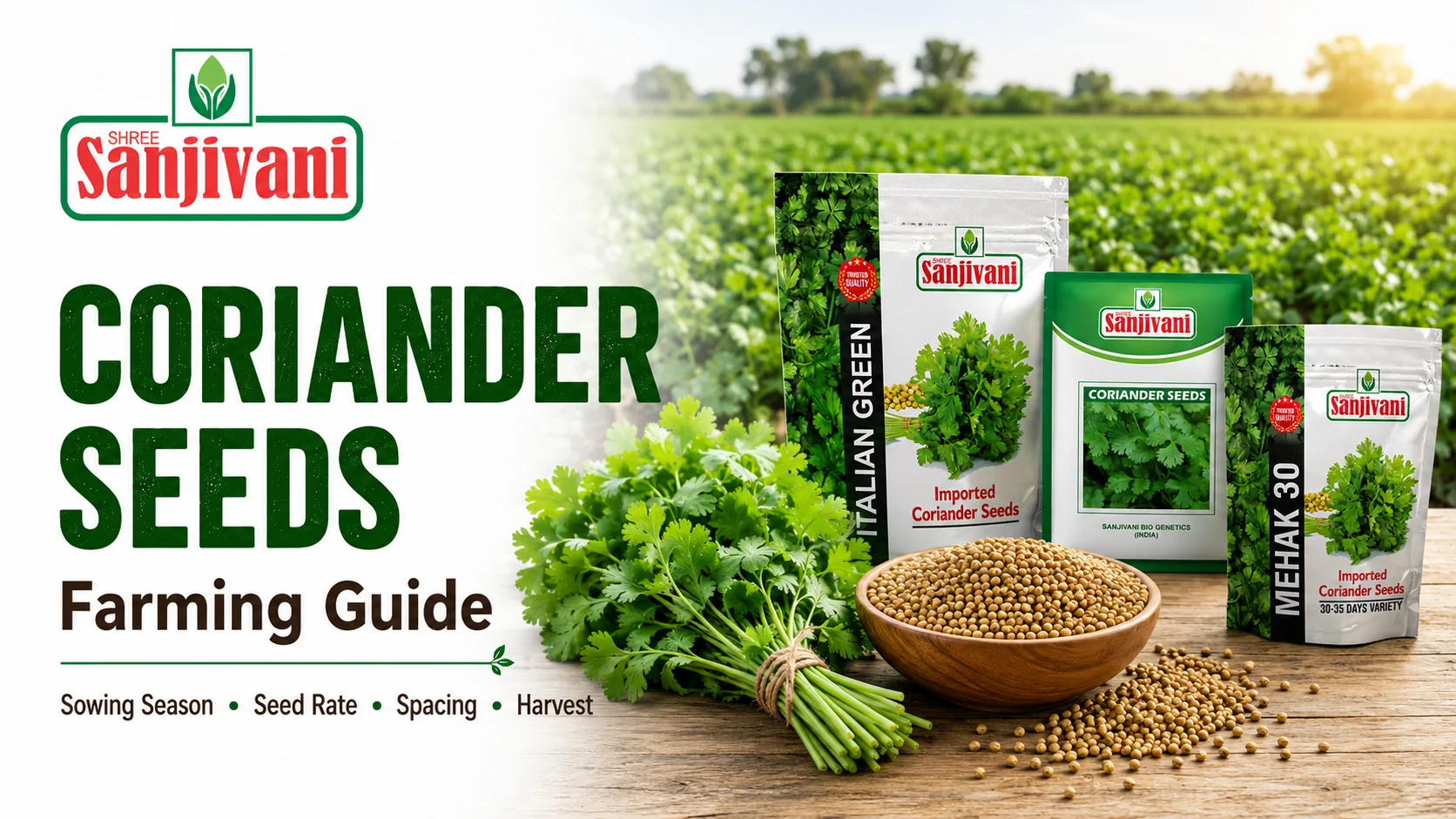
Coriander Farming in India: Seed Rate, Yield and Crop Duration
Coriander can be grown for fresh green leaves, mature dhaniya grain or both, and that purpose changes the way the crop should be planned. Seed quantity, plant density, harvest stage and crop duration are not necessarily the same for a leafy crop and a crop being taken to full seed maturity.
For most farmers, the useful decisions come before sowing: how much seed is needed, when the crop should be planted, whether irrigation is available, how the variety fits the local season and whether the intended market is for fresh leaves or mature coriander grain.
Quick answer: For an irrigated line-sown coriander crop, about 4–5 kg of seed per acre or 10–12 kg per hectare is a useful reference. Rainfed recommendations may be around 8–10 kg per acre or 20–25 kg per hectare. Coriander generally germinates in about 8–15 days. Fresh leaves may be harvested around 30–40 days after sowing, while a crop grown for mature grain commonly takes around 90–110 days.
These figures are starting points rather than fixed targets for every field. Variety, seed quality, sowing method, local climate and crop purpose should decide the final plan.
Coriander Cultivation at a Glance
| Factor | Practical reference |
|---|---|
| Main grain sowing period | October to November in many Indian growing regions |
| Irrigated seed rate | About 10–12 kg/ha, roughly 4–5 kg/acre |
| Rainfed seed rate | About 20–25 kg/ha, roughly 8–10 kg/acre |
| Spacing reference | Around 20 × 15 cm for a line-sown crop; recommendations vary with purpose and region |
| Germination | Usually around 8–15 days under suitable conditions |
| Fresh-leaf harvest | Often around 30–40 days |
| Mature grain crop | Commonly around 90–110 days, depending on variety |
Decide Whether the Crop Is for Green Leaves or Coriander Grain
The first decision in coriander farming is the harvest you want to sell.
A grower producing fresh dhaniya wants good leaf colour, aroma, tenderness and a harvest schedule that matches local vegetable demand. A grower carrying the crop to maturity is more concerned with flowering, grain development, maturity and the quality of the harvested coriander seed.
Some varieties are useful for leafy production, others are grown mainly for grain, and some can be used for both. This distinction is more useful than looking for one variety described as the best for every purpose.
Farmers who rotate several leafy crops may also compare the crop calendar with methi farming , especially when labour, irrigation and the next crop need to fit into the same season.
Choosing a Coriander Variety
Variety selection should follow the planned harvest rather than the variety name alone.
| Type | Main use | What to compare |
|---|---|---|
| Leafy coriander | Fresh green dhaniya | Leaf colour, aroma, vegetative growth, bolting behaviour and cutting quality |
| Grain coriander | Mature spice seed | Crop duration, grain characteristics, maturity and regional performance |
| Dual-purpose type | Leaves followed by grain where suitable | Ability to fit both harvest stages into the farm and market plan |
When comparing seed lots, the crop name is only one part of the decision. Variety identity, germination information, packet condition and the intended production system also matter when choosing good quality seeds .
Best Time to Sow Coriander in India
For coriander grown to mature grain, October to November is an important sowing period across many Indian production regions. Cooler and relatively dry conditions during crop development and grain formation are generally favourable.
That does not mean every coriander crop in India should be planted on the same date. Regional rainfall, soil moisture, irrigation and the intended harvest all influence the sowing window.
Coriander grown mainly for leaves can also be planted during other suitable periods when temperature, water and market conditions allow. Some production systems use monsoon sowing, but drainage becomes particularly important when rainfall is high.
Soil and Growing Conditions
Coriander performs well in well-drained soil and generally favours comparatively cool conditions. A fine, reasonably level seedbed helps with shallow sowing and more even establishment.
Poor drainage is particularly undesirable because prolonged waterlogging can interfere with emergence and increase root and disease problems.
Before sowing, break large clods, remove heavy crop residue where necessary and prepare the surface so the small split seed can be placed at a shallow and reasonably uniform depth.
Coriander Seed Rate per Acre and per Hectare
For an irrigated line-sown coriander crop, 10–12 kg of seed per hectare is a useful reference, equal to approximately 4–5 kg per acre.
Under rainfed conditions, the recommended quantity can be higher. A common reference is 20–25 kg per hectare, or roughly 8–10 kg per acre.
| Growing situation | Seed rate per acre | Seed rate per hectare |
|---|---|---|
| Irrigated line-sown crop | About 4–5 kg | About 10–12 kg |
| Rainfed crop | About 8–10 kg | About 20–25 kg |
| Dense crop for fresh leaves | Use the recommendation for the selected leafy variety and production method rather than applying the grain-crop rate automatically | |
The difference between these rates is one reason a seed-rate figure should not be copied from another field without understanding how the crop is being grown.
For example, an irrigated two-acre field using a reference rate of 4.5 kg per acre would require about 9 kg of seed before allowing for actual pack sizes. If germination is poor, simply increasing the quantity is not always the best solution; the seed lot and establishment conditions should be checked first.
How to Sow Coriander Seeds
What is commonly called a coriander seed is actually a dry fruit containing two seed units. Before sowing, the fruits are usually rubbed or split gently into halves so the seed units can establish more evenly.
The aim is to separate the halves without crushing the seed.
Line sowing
Line sowing makes thinning, weeding, irrigation and crop inspection easier than an irregular broadcast stand.
A spacing of around 20 × 15 cm is one established reference for coriander cultivation. Wider or denser arrangements may be used according to crop purpose, variety and local recommendations.
Sowing depth
Coriander should be sown relatively shallowly in a fine seedbed. Deep sowing can delay or reduce emergence, particularly when soil crusting occurs after irrigation or rainfall.
After sowing, maintain enough moisture for germination without keeping the seedbed continuously saturated.
How Long Coriander Seeds Take to Germinate
Coriander commonly germinates in about 8–15 days when viable split seed is sown at a suitable depth in moist, well-drained soil.
Emergence can become slower or less even when:
- seed has been stored poorly or has low viability;
- whole fruits are sown without splitting;
- seed is placed too deep;
- the upper soil layer dries during germination;
- the field remains excessively wet;
- soil crusting prevents seedlings from emerging evenly.
If establishment is unexpectedly poor, look at the seed lot and field conditions before assuming that a higher seed rate will solve the problem.
Irrigation and Crop Establishment
Moisture is particularly important during germination and early growth. Irrigation should wet the seed zone without leaving the field waterlogged.
As plants establish, irrigation frequency depends on soil type, temperature, rainfall and the stage of the crop. Lighter soils may lose moisture more quickly than heavier soils, while poorly drained fields require greater care to avoid prolonged saturation.
Nutrition should also be based on soil fertility and local recommendations rather than one fixed fertiliser schedule for every farm.
Early Crop Care and Common Field Problems
Coriander seedlings establish slowly enough that weeds can compete strongly during early crop growth. Keeping the field reasonably clean during establishment helps the crop develop a more uniform stand.
Regular field observation is also important because coriander can be affected by problems such as aphids, powdery mildew, wilt, root problems and stem gall depending on the season and production region.
Good drainage, sensible plant density, clean seed, crop rotation and timely removal of severely affected plants can reduce avoidable pressure. When a pest or disease requires treatment, follow locally registered recommendations from an agricultural extension specialist rather than applying a product only from a general internet recommendation.
Coriander Crop Duration and Harvesting Time
Crop duration depends mainly on whether coriander is being grown for leaves or mature grain.
| Crop purpose | Typical harvest stage | Approximate duration |
|---|---|---|
| Fresh green coriander | Plants or leaves harvested while green and marketable | Often around 30–40 days |
| Multi-cut leafy variety | Successive cuts where the variety has good regrowth | Variety and management dependent |
| Mature coriander grain | Harvest as fruits mature and plants begin drying | Commonly around 90–110 days |
For a grain crop, waiting too long after full maturity can increase losses through shattering. Plants are generally harvested as the fruits mature and the crop begins to dry, then dried further before threshing and cleaning.
For leafy coriander, the harvest should be timed around leaf quality and market demand rather than waiting for the plant to enter seed production.
Coriander Yield per Acre and per Hectare
Coriander yield varies widely with the variety, crop purpose and production system, so one figure should not be presented as the expected output of every farm.
As a general reference, one established cultivation guide gives around 300–400 kg of grain per hectare under rainfed conditions and about 500–600 kg per hectare under irrigated conditions.
That converts to roughly:
| Output | Reference per acre | Reference per hectare |
|---|---|---|
| Rainfed grain | About 120–160 kg | About 300–400 kg |
| Irrigated grain | About 200–240 kg | About 500–600 kg |
| Fresh leaves | Around 2.4–2.8 tonnes in the referenced production system | Around 6–7 tonnes |
These figures should be treated as references, not a ceiling or guarantee. Variety-specific performance can be considerably different. Improved coriander varieties and multi-cut leafy types may have very different yield potential from the general ranges above.
The final output depends on crop stand, variety, sowing date, soil, irrigation, nutrition, disease pressure and harvest losses.
The seed-rate, germination, harvest and general yield references used here are consistent with TNAU coriander cultivation guidance .
Drying and Storing Coriander Grain
Coriander intended for grain should be dried properly after harvest before it is packed or stored. Excess moisture increases the risk of deterioration during storage.
Use clean, dry bags or containers, protect the grain from moisture and pests, and avoid direct contact with a damp floor.
Seed that is being retained specifically for future sowing should receive greater attention to storage conditions because germination can decline when seed is exposed to heat, moisture or poor storage for long periods.
Choosing Coriander Seed for the Planned Crop
The crop purpose should guide the product choice. A grower mainly targeting leafy dhaniya may prefer a variety selected for vegetative growth and leaf quality, while a grain producer should look more closely at maturity, seed characteristics and field performance.
For commercial leafy or grain production, Italian Green coriander seeds and Mehak-30 coriander seeds are among the currently listed 1 kg options.
Growers primarily interested in fresh green leaf production can also compare Sanjivani OP Super Green Dhaniya with their local crop requirement.
Price and stock can change, so the live product page should be used for current pack, availability and ordering information rather than relying on an old article price.
Frequently Asked Questions About Coriander Farming
What is the coriander seed rate per acre?
For an irrigated line-sown crop, about 4 to 5 kg of coriander seed per acre is a useful reference. Rainfed recommendations may be around 8 to 10 kg per acre. The final rate should follow the variety, sowing method and local recommendation.
What is the coriander seed rate per hectare?
About 10 to 12 kg per hectare is a common reference for irrigated coriander, while rainfed cultivation may use around 20 to 25 kg per hectare.
Which month is best for sowing coriander in India?
October to November is an important sowing period for coriander grown to grain in many regions. Leaf production and some regional systems may use other sowing windows, so local weather and the variety recommendation should be considered.
How many days do coriander seeds take to germinate?
Coriander commonly germinates within about 8 to 15 days when viable split seed is sown shallowly in a moist, well-drained seedbed.
How long does a coriander crop take?
Fresh green coriander can often be harvested around 30 to 40 days after sowing. A crop grown for mature coriander grain commonly takes around 90 to 110 days, depending on the variety and growing conditions.
What is the coriander yield per acre?
A general reference is around 120 to 160 kg of grain per acre under rainfed conditions and about 200 to 240 kg per acre under irrigated conditions. Variety-specific yields can differ considerably, so these figures should not be treated as a guarantee.
Should coriander seeds be split before sowing?
Yes. Coriander fruits contain two seed units and are commonly split gently before sowing. This usually gives more even establishment than sowing intact fruits.
Which coriander variety is best for farming?
There is no one coriander variety that is best for every farm. Choose according to whether the crop is intended for fresh leaves, mature grain or both, then consider the local season, maturity, market requirement and regional performance.
Conclusion
Coriander farming becomes easier to plan once the final harvest is clear. A crop intended for fresh leaves has a different timeline and plant-density requirement from one being grown to mature grain.
For an irrigated line-sown crop, about 4–5 kg of seed per acre is a useful starting reference, while rainfed situations may require more. October to November is an important grain-crop sowing period in many regions, germination commonly takes about 8–15 days, and mature seed crops often need around 90–110 days.
Use those figures as planning references, then adjust the final decision to the selected variety, local growing conditions and the way the crop will be harvested and sold.